
What We Learned from Bhopal: How Far Can a Workplace Accident Reach?
In Bhopal, an error inside the plant spread to the neighbourhoods beyond its fence, and its effects have lasted for more than forty years. Lessons for occupational safety, the human factor and technology.

For more than forty years, Bhopal has been one of the defining cases in occupational and process safety.
On the night of 2 to 3 December 1984, water entered a tank holding about 40 tonnes of methyl isocyanate at a pesticide plant in Bhopal, India. The runaway reaction released a toxic gas that spread over the neighbourhoods next to the plant. According to a peer-reviewed review, about 3,800 people died immediately; gas-related premature deaths over the next two decades are estimated at 15,000 to 20,000.
The core problems behind a disaster
That night, none of the safety systems did its job. Refrigeration had been off for months to save money; the gas scrubber was on standby, the flare was out of service for maintenance, and the water curtain could not reach the height at which the gas escaped. There was no alarm to warn people outside the plant. Staffing, maintenance and training had been cut in the preceding years.
The most important lesson: preventing an accident is possible not by knowing the hazard, but by acting before it materialises.
The error that triggered it, the decisions that magnified it
According to the official investigation, water reached the tank while lines were being washed without a slip blind; when the pressure rose, the gauge was assumed to be faulty. Union Carbide argued that an employee had committed sabotage. Whichever explanation is right, that error on the shop floor would not have been enough on its own. What magnified it were decisions taken months earlier: switching off refrigeration, deferring maintenance, cutting staff and training. The conviction in 2010 of seven former executives for causing death by negligence also showed that responsibility did not lie on the shop floor alone.
Three core lessons for occupational safety
- Identify risks in advance: Switching off refrigeration was a change that never went through risk assessment. Every change to a hazardous process should be assessed; protective measures, maintenance and inspection should go together.
- Do not overlook the human factor: Operators whose training had been cut took a real hazard for a faulty instrument. Training, safety culture and decision-making are part of a safe system of work.
- Be ready for emergencies: The public and hospitals did not know what the gas was. Warning systems, evacuation plans and response procedures should be tested through regular drills.
How does technology strengthen preventive safety?
Today’s digital tools could have made many links in the Bhopal chain visible:
- Sensors and AI: A model reading pressure, temperature and gas data together can catch the “faulty gauge” assumption.
- Digital permits to work: Washing cannot start until the slip blind is confirmed as fitted.
- Barrier tracking: Which safety systems are out of service is visible on one screen.
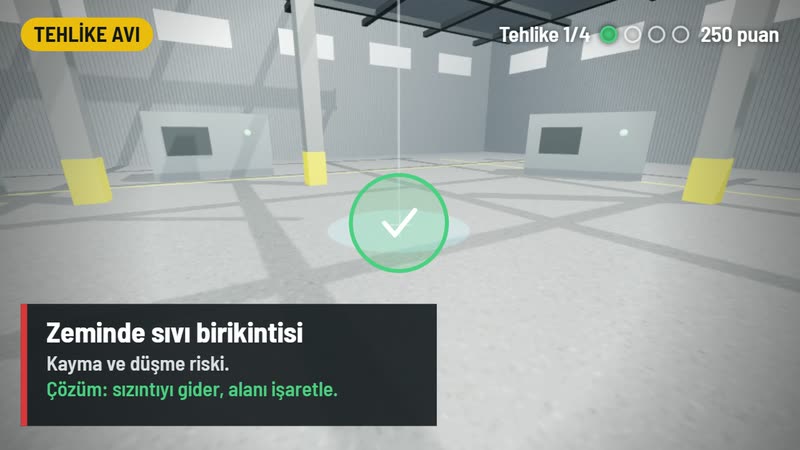
- VR training: Operators rehearse situations such as an abnormal pressure rise without real-world risk.
But technology cannot stand in for a decision to switch off refrigeration. Digital solutions do not replace sound risk analysis, competent workers and workable procedures; they strengthen them.
How long does a workplace accident last?
A workplace accident is usually recorded as the event of a single day. Bhopal shows that its effects can reach far beyond both the factory wall and that night. According to the Bhopal Medical Appeal, in the years before 1984 the plant left its waste inside the site and in evaporation ponds outside it. The waste seeped into the groundwater; contaminated wells today affect tens of thousands of families in 42 neighbourhoods. Among those exposed to the gas, chronic lung and kidney disease, miscarriages and birth problems are still seen. The Sambhavna Clinic, which gives survivors free healthcare, and the Chingari Centre, for children from gas- and water-affected families, work with the BMA’s support. More than forty years on, generations not yet born that night are still paying its price. More at bhopal.org
Conclusion: error is inevitable, disaster is not
What made Bhopal a disaster was not a single error but the removal, one by one, of the layers that could have stopped it. In Turkey, major industrial accidents have been covered by a dedicated regulation since 2019; the real difference, though, lies in keeping those layers working on site.
At Imverge, our VR scenarios measure a worker’s gaze and reaction time in the face of a hazard, so that a missed signal like the one in Bhopal can be seen during training.
Watch
We recommend The Railway Men (Netflix, 2023), which tells the story of that night through the railway workers who tried to save people. It is a dramatisation, but it shows powerfully what the absence of emergency preparedness costs. Watch on Netflix
Sources
- Broughton, E. (2005). The Bhopal disaster and its aftermath: a review. Environmental Health, 4, 6.
- IChemE (1985). Bhopal. Loss Prevention Bulletin 063.
- Macleod, F. (2014). Impressions of Bhopal. Loss Prevention Bulletin 240.
- Bhopal Medical Appeal. Bhopal’s Second Disaster and Health Holocaust.
- Associated Press (2010). Indian court convicts 7 in Bhopal gas disaster.